

What Is Dry Needling? How It Unlocks Stubborn Muscle Knots
That stubborn, aching knot in your neck, shoulder, or lower back often isn't just a tight muscle. It is a hyperirritable band of tissue, clinically known as a myofascial trigger point. Dry needling is a targeted, evidence-based physical therapy intervention engineered to deactivate these trigger points, restore blood flow, and reset dysfunctional muscle tissue.
How Dry Needling Releases Trigger Points
When a muscle fiber is overused, held in poor posture, or subjected to sustained trauma, it can contract so tightly that it cuts off its local blood supply. This creates a painful cycle: localized hypoxia (lack of oxygen), a buildup of inflammatory metabolic waste, and persistent pain signals sent to the brain.
Dry needling interrupts this cycle by using fine, sterile, solid-filament needles inserted directly into the affected muscle tissue.
The Local Twitch Response (LTR): Inserting the needle into a trigger point stimulates an involuntary spinal cord reflex, causing the muscle to twitch and instantly drop its resting tension.
Restored Microcirculation: The mechanical stimulation triggers localized vasodilation, increasing oxygen delivery and flushing out inflammatory chemical mediators.
Neuromuscular Reset: By disrupting peripheral pain pathways, dry needling helps reboot the nervous system's control over the muscle, allowing it to contract and relax normally.
Recent clinical literature published in the National Institutes of Health (PMC) confirms that dry needling significantly increases pain pressure thresholds, decreases pain intensity, and accelerates functional recovery in patients suffering from musculoskeletal pain syndromes.
Dry Needling vs. Acupuncture: What's the Difference?
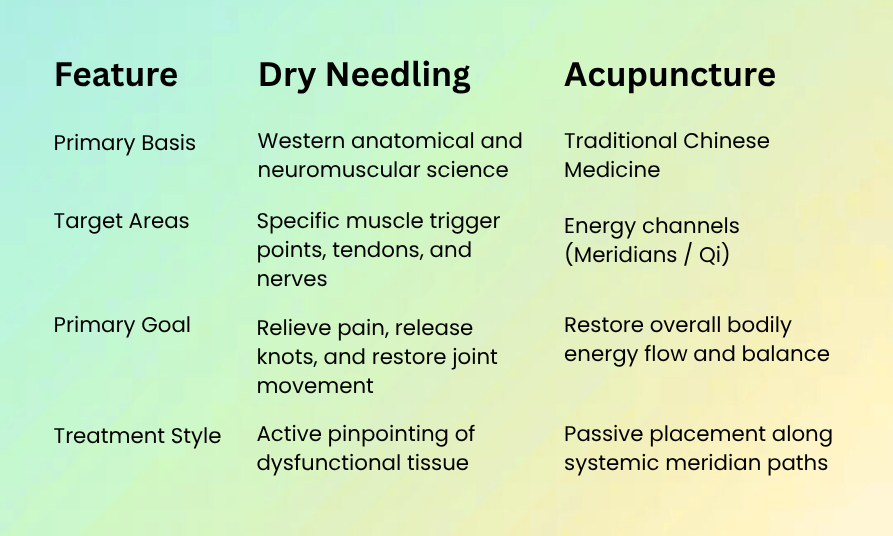
While both techniques use similar thin needles, their underlying philosophies and target points differ completely:
Key Conditions Dry Needling Can Treat
Dry needling is highly versatile and frequently integrated into broader physical therapy and sports performance plans:
Spine & Posture: Chronic lower back tightness, upper trapezius knots, and neck stiffness.
Overuse & Sports Injuries: Golfer's or tennis elbow, rotator cuff tightness, hamstring strains, and IT band irritation.
Joint Dysfunction: Hip flexor tightness, knee tracking issues, and plantar fasciitis.
What to Expect During Your Session
Treatment begins with a thorough movement assessment to identify the exact muscles driving your limitation. As the needle reaches the trigger point, you may feel a brief sensation similar to a mild muscle cramp or quick twitch; this is the local twitch response and a sign that the muscle is releasing.
Most patients experience immediate improvements in joint range of motion and reduced tightness, followed by mild, workout-like soreness for 24 to 48 hours.
"I’m a nurse, a bodybuilder, and I teach yoga, and dry needling really has made all that possible for me. I know needles can be a little bit scary... but I feel very relaxed and able to breathe through it. Afterward, when I go to the gym or go to work, I feel like I can move better with less pain and better range of motion. I would recommend it to everyone." — PerformanceAbove Patient
Ready to Unlock Your Stubborn Pain?
Persistent muscle knots don't have to dictate your daily comfort or athletic performance. By combining precision dry needling with targeted movement retraining, you can eliminate deep tightness and move freely again.
Book your Dry Needling Assessment at PerformanceAbove today and start living pain-free.
Blog References
Chys, M., De Meulemeester, K., De Greef, I., Murillo, C., Kindt, W., Kouzouz, Y., Lescroart, B., & Cagnie, B. (2023). Clinical effectiveness of dry needling in patients with musculoskeletal pain—an umbrella review. Journal of Clinical Medicine, 12(3), 1205.
McAphee, D., Bagwell, M., & Falsone, S. (2022). Dry needling: A clinical commentary. International Journal of Sports Physical Therapy, 17(4), 551–555.
Not all exercises are for everyone. Before attempting a new exercise, take into account factors such as flexibility, strength, and overall health to determine whether a particular exercise is appropriate for you.
This, like any other exercise, can result in personal injury. Any injury sustained from proper or improper use of this exercise is solely the responsibility of the exerciser. Performanceabove LLC disclaims any liability from injury sustained from the use of this exercise and suggests that you consult your professional healthcare provider before attempting any exercise or exercise program.
