

The Biggest Myth About Aging: That Slowing Down Is Normal
We've all heard it or perhaps even caught ourselves saying it: I'm just slowing down a bit; it comes with age.
It's one of the most pervasive myths in modern health. We treat a decline in walking speed, reduced step length, or taking longer to cross the street as a harmless, natural milestone of growing older. But from a physical therapy and movement perspective, slowing down isn't just an inevitable side effect of birthdays; it is a clear, actionable signal from your body.
At PerformanceAbove, we believe aging shouldn't mean accepting physical decline. Science continuously shows that your walking speed isn't just a habit; it is a direct window into your overall health, vitality, and longevity.
Walking Speed: The "Functional Vital Sign" You Aren't Tracking
When you go to the doctor, they check your blood pressure, pulse, and temperature. But leading clinical experts argue there is a critical missing metric: your gait speed.
The American Physical Therapy Association (APTA), supported by extensive research in geriatric rehabilitation, advocates for measuring gait speed as a routine assessment of functional mobility. Why? Because how fast and efficiently you walk tells a comprehensive story about how well your cardiovascular, nervous, and musculoskeletal systems are working together.
In a comprehensive review published in the Journal of Geriatric Physical Therapy, researchers Middleton, Fritz, and Lusardi established that walking speed functions as a true "functional vital sign." Their findings showed that gait speed reliably predicts:
Risk of hospitalization
Frequency of falls
Onset of cognitive decline
Ability to maintain independent living
When your walking speed slows, it is often the first visible sign that your balance, muscular strength, or joint control is declining, long before a major injury or fall occurs.
What the Science Says: Gait Speed and Longevity
If you think walking speed only matters for getting across the parking lot faster, the medical literature suggests otherwise. Your pace is intimately tied to your lifespan.
In a landmark study published in JAMA, researchers analyzed pooled data from over 34,000 older adults. The result? Gait speed strongly predicted survival and future disability. Across all age groups, faster walkers consistently lived longer than slower walkers, demonstrating that physical velocity is closely linked to biological resilience.
When you maintain your walk speed, you aren't just moving faster; you are preserving the physiological reserve that protects your body against illness, frailty, and injury.
The Hidden Engine: Muscle Strength and Balance
Why do people slow down in the first place? It rarely happens overnight. Instead, it is the result of subtle, cumulative losses in lower-body strength and dynamic balance.
Walking efficiently requires more effort than simply swinging your legs forward. It demands:
Lower-Body Power: Muscle groups like your glutes, quadriceps, and calves must generate enough force to propel you forward.
Postural Control: Your core and hip stabilizers must keep you steady while standing on one leg for a fraction of a second with every single step.
The connection between strength and speed is clear: individuals with stronger lower-body muscles and superior balance consistently demonstrate faster, more efficient walking speeds. More importantly, this enhanced power drastically lowers their risk of falls, allowing them to navigate uneven terrain, stairs, and busy environments with complete confidence.
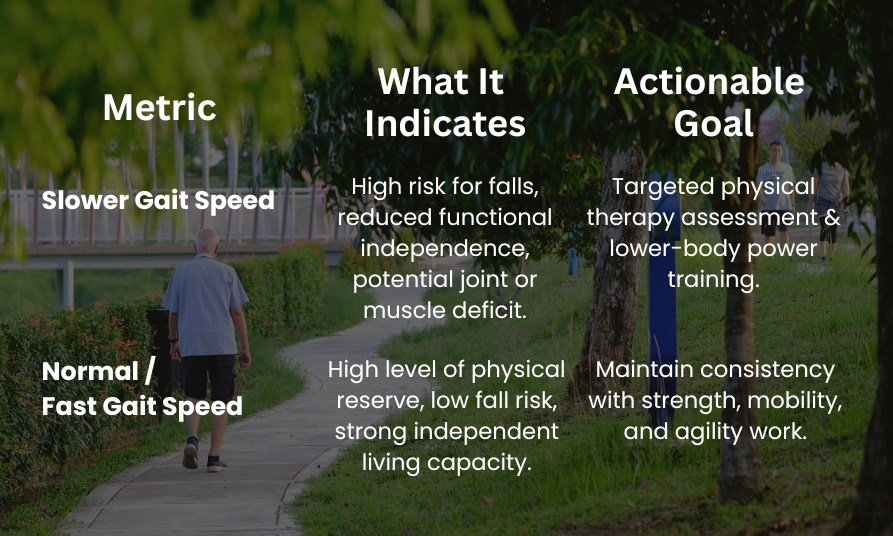
Gait Speed as a Health Metric
Understanding where your mobility stands helps you take proactive steps toward active aging:
How to Reclaim Your Speed and Independence
The best news about gait speed? It is entirely trainable. Slowing down doesn't have to be your default setting. By addressing the root physical drivers of gait decline, you can rebuild your power and pace:
Prioritize Side & Rear Hip Strength: Strong side glutes (gluteus medius) keep your hips level during your stride, preventing wobbling and wasted energy.
Train Single-Leg Stability: Every step you take is a temporary single-leg balance test. Incorporate step-downs and single-leg balance drills into your weekly routine.
Work on Joint Mobility: Stiff ankles or hips force your body to take shorter, slower steps. Keeping these joints loose ensures a full, natural stride.
Take Control of Your Longevity at PerformanceAbove
If you’ve noticed your stride slowing down or if morning stiffness and balance concerns are holding you back from the activities you love, don't wait for a fall to take action.
At PerformanceAbove, we specialize in functional movement assessments that look beyond superficial symptoms. We measure your gait mechanics, joint mobility, and lower-body power to build a targeted plan that restores your confidence, protects your independence, and keeps you performing at your best.
Book your comprehensive movement assessment with PerformanceAbove today and take the first step toward moving faster, feeling stronger, and living better.
Blog References
Middleton, A., Fritz, S. L., & Lusardi, M. (2015). Walking speed: The functional vital sign. Journal of Geriatric Physical Therapy, 38(2), 64–73.
Studenski, S., Perera, S., Patel, K., Rosano, C., Faulkner, K., Inzitari, M., Brach, J., Chandler, J., Cawthon, P., Connor, E. B., Nevitt, M., Visser, M., Kritchevsky, S. B., Badinelli, S., Harris, T. B., Newman, A. B., Cauley, J., Ferrucci, L., & Guralnik, J. M. (2011). Gait speed and survival in older adults. JAMA, 305(1), 50–58.
Not all exercises are for everyone. Before attempting a new exercise, take into account factors such as flexibility, strength, and overall health to determine whether a particular exercise is appropriate for you.
This, like any other exercise, can result in personal injury. Any injury sustained from proper or improper use of this exercise is solely the responsibility of the exerciser. Performanceabove LLC disclaims any liability from injury sustained from the use of this exercise and suggests that you consult your professional healthcare provider before attempting any exercise or exercise program.
